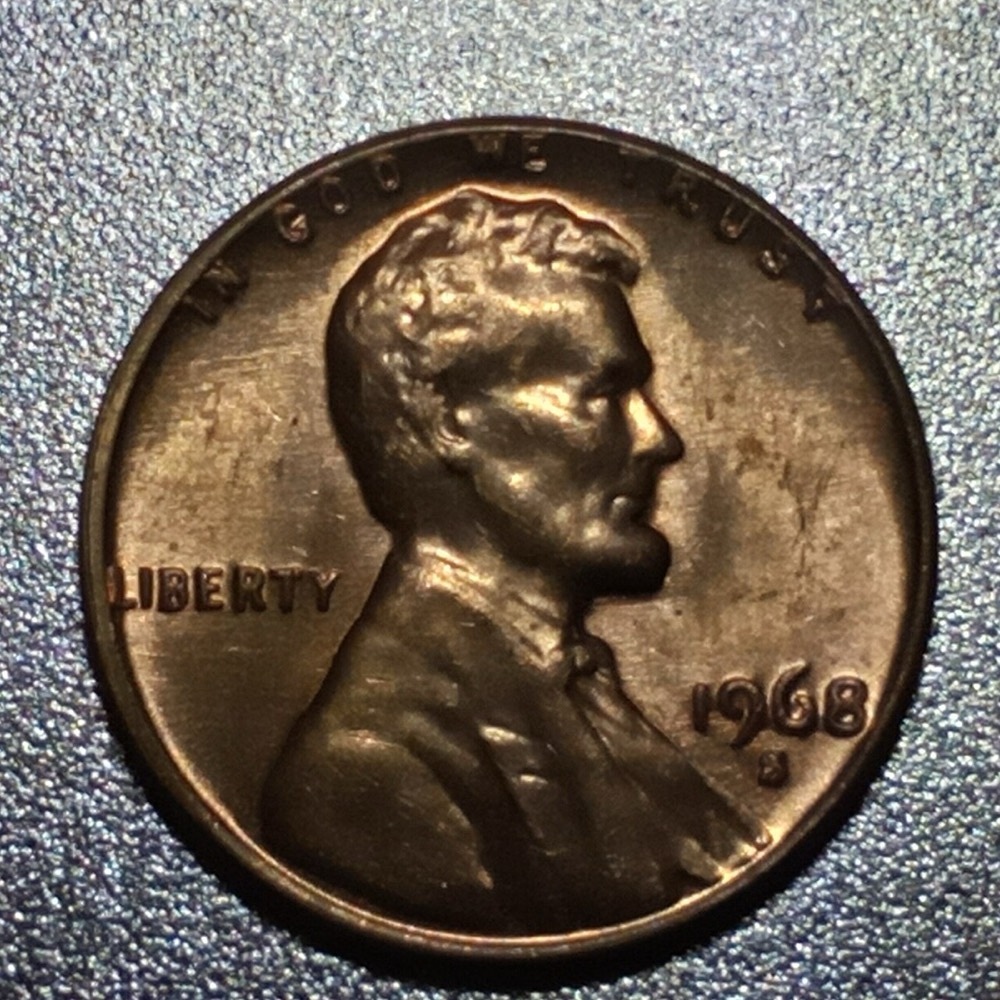
1968 Penny Value: Price Chart by Grade & Mint Mark
Quick answer
1968 penny value: PCGS lists $18 in MS65. Mintage, mint marks and what to check.
Updated 2026-09-25 · Sources: PCGS CoinFacts, Wikipedia
Have one? Scan it to see what it's worth.
Download on the App StoreWhat are the key facts?
- Year: 1968
- Reverse design: Memorial reverse (1959-2008)
- Composition: 95% copper, 5% zinc (brass, called "bronze" by the Mint)
- Weight: 3.11 g
- Diameter: 19.05 mm
- Mintage, no mint mark (Philadelphia): 1,707,880,970 circulation strikes
- Mintage, D (Denver): 2,886,269,600 circulation strikes
- Mintage, S (San Francisco): 258,270,001 circulation strikes
- Mintage, S (San Francisco): 3,041,506 proofs
- Value, MS65 RD (1968, PCGS): $18
How many 1968 pennies were made
In 1968 the U.S. Mint struck about 4.85 billion Lincoln cents for circulation: Philadelphia 1.71 billion, Denver 2.89 billion, San Francisco 258.3 million. That is 59% more than 1967. Among the 117 years from 1909 to 2025, 1968 ranks number 54 by total mintage (1 = most coins made), so it is a mid-range date for availability. The scarcest 1968 issue by mintage is San Francisco (258,270,001); the most common is Denver (2,886,269,600). Within the 1960s, 1968 ranks 3 of 10 years for mintage; the decade's high was 1964 (6.45 billion) and its low was 1965 (1.50 billion). Mint by mint: Philadelphia rose 88% from 1967; Denver rose 117% from 1967; San Francisco fell 68% from 1967. Proof cents for collectors: 3,041,506 from San Francisco.
Mint marks on a 1968 penny
The mint mark, if any, sits under the date on the front of the coin. A 1968 cent with no mint mark was struck at Philadelphia and is the normal, common form for that mint. The letters you can find on 1968 circulation cents are D (Denver) and S (San Francisco). Proof cents carry an S and have mirror-like fields; they came from collector sets, not from circulation.
What to check on a 1968 penny
- Cents from this era are 95% copper and weigh 3.11 g. A coin with this date that weighs about 2.5 g is a plated or altered piece, not a transitional error (zinc cents only begin in 1982). Small raised blobs or lines between letters, especially between the B and E of LIBERTY, are die breaks (collectors call them BIE cents); they are common and carry little premium.
- Before anything else, confirm the date and mint mark are fully readable and that the surfaces have not been cleaned; the dates and mint marks guide shows what cleaning and machine doubling look like.
How much is a 1968 penny worth?
PCGS Price Guide values for 1968 cents (updated September 24, 2026, U.S. dollars, for coins certified by PCGS):
- 1968: $8 in MS63 RD and $18 in MS65 RD.
- 1968-D: $6 in MS63 RD and $14 in MS65 RD.
- 1968-S: $3 in MS63 RD and $14 in MS65 RD.
San Francisco is the lowest-mintage 1968 issue (258,270,001 struck), so it is the mint collectors check first. Guide prices assume a certified coin; an uncertified, worn 1968 cent usually sells for less than the lowest figure above, often little more than face value. RD means full original red copper, RB red-brown, BN brown; the color grade can multiply the price. How grade and variety turn into a number is explained in what makes a coin valuable.
FAQ
Is a 1968 penny with no mint mark rare?
No. A 1968 cent without a mint mark is the normal Philadelphia strike, and 1,707,880,970 were made.
What does the D on a 1968 penny mean?
D means the coin was struck at the Denver Mint. Denver made 2,886,269,600 cents in 1968, the most of any mint that year.
Is a 1968-S penny valuable?
S means San Francisco, which struck 258,270,001 circulation cents in 1968, the lowest mintage of the year, so it is the issue collectors look for first. Value still depends on grade and on whether the coin is a recognised variety.
More in Lincoln Penny Value by Year: 1909–2025 Price Chart
- 1960 Penny Value: Price Chart by Grade & Mint Mark
- 1961 Penny Value: Price Chart by Grade & Mint Mark
- 1962 Penny Value: Price Chart by Grade & Mint Mark
- 1963 Penny Value: Price Chart by Grade & Mint Mark
- 1964 Penny Value: Price Chart by Grade & Mint Mark
- 1965 Penny Value: Price Chart by Grade & Mint Mark
- 1966 Penny Value: Price Chart by Grade & Mint Mark
- 1967 Penny Value: Price Chart by Grade & Mint Mark
- 1969 Penny Value: 1969-S Doubled Die Price Chart
Related
See what your coins are really worth.
Start with a single scan.
Have one? Scan it to see what it's worth.
Sources
- PCGS CoinFactswww.pcgs.com/prices/detail/lincoln-cent-modern/47/most-active
- Wikipediaen.wikipedia.org/wiki/Lincoln_cent_mintage_figures
- Wikipediaen.wikipedia.org/wiki/Lincoln_cent
Compiled by the CoinLens editorial team
Every fact on this page is taken from the sources listed above; numbers and prices are copied from the source, and prices name the guide or auction and its date. Research and drafting were assisted by AI, and each claim was then checked against the cited sources. Checked 2026-09-25. We do not buy, sell or grade items; the app identifies what you photograph and points you to these references.