1974 Penny Value: Price Chart by Grade & Mint Mark
Quick answer
1974 penny value: PCGS lists $18 in MS65; the 1974-D Aluminum reaches $250,000. Mintage, mint marks and what to check.
Updated 2026-09-25 · Sources: PCGS CoinFacts, Wikipedia, coinvaluechecker.com
Have one? Scan it to see what it's worth.
Download on the App StoreWhat are the key facts?
- Year: 1974
- Reverse design: Memorial reverse (1959-2008)
- Composition: 95% copper, 5% zinc (brass, called "bronze" by the Mint)
- Weight: 3.11 g
- Diameter: 19.05 mm
- Mintage, no mint mark (Philadelphia): 4,103,183,000 circulation strikes
- Mintage, no mint mark (West Point): 128,957,523 circulation strikes
- Mintage, D (Denver): 4,235,098,000 circulation strikes
- Mintage, S (San Francisco): 409,426,660 circulation strikes
- Mintage, S (San Francisco): 2,612,568 proofs
- Value, MS65 RD (1974, PCGS): $18
- Top variety (PCGS): 1974-D Aluminum: up to $250,000
How many 1974 pennies were made
In 1974 the U.S. Mint struck about 8.88 billion Lincoln cents for circulation: Philadelphia 4.10 billion, West Point 129.0 million, Denver 4.24 billion, San Francisco 409.4 million. That is 17% more than 1973. Among the 117 years from 1909 to 2025, 1974 ranks number 29 by total mintage (1 = most coins made), so it is one of the most common dates in the series. The scarcest 1974 issue by mintage is West Point (128,957,523); the most common is Denver (4,235,098,000). Within the 1970s, 1974 ranks 5 of 10 years for mintage; the decade's high was 1979 (10.16 billion) and its low was 1971 (5.36 billion). Mint by mint: Philadelphia rose 10% from 1973; West Point did not strike circulation cents in 1973; Denver rose 19% from 1973; San Francisco rose 29% from 1973. Proof cents for collectors: 2,612,568 from San Francisco.
Mint marks on a 1974 penny
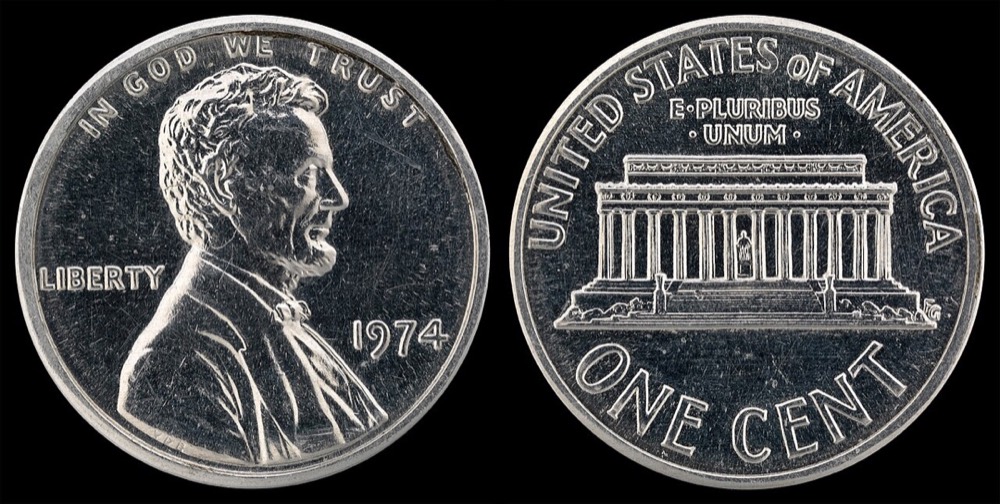
The mint mark, if any, sits under the date on the front of the coin. A 1974 cent with no mint mark was struck at Philadelphia or West Point (the two cannot be told apart) and is the normal, common form for that mint. The letters you can find on 1974 circulation cents are D (Denver) and S (San Francisco). Proof cents carry an S and have mirror-like fields; they came from collector sets, not from circulation.
What to check on a 1974 penny
- Between 1974 and 1986 the West Point facility also struck cents, without any mint mark. A cent from these years with no mint mark can therefore be from Philadelphia or West Point; the two cannot be told apart, and neither is scarce.
- Cents from this era are 95% copper and weigh 3.11 g. A coin with this date that weighs about 2.5 g is a plated or altered piece, not a transitional error (zinc cents only begin in 1982). Small raised blobs or lines between letters, especially between the B and E of LIBERTY, are die breaks (collectors call them BIE cents); they are common and carry little premium.
- Before anything else, confirm the date and mint mark are fully readable and that the surfaces have not been cleaned; the dates and mint marks guide shows what cleaning and machine doubling look like.
How much is a 1974 penny worth?
PCGS Price Guide values for 1974 cents (updated September 24, 2026, U.S. dollars, for coins certified by PCGS):
- 1974: $7 in MS63 RD and $18 in MS65 RD.
- 1974-D: $5 in MS63 RD and $15 in MS65 RD.
- 1974-S: $7 in MS63 RD and $20 in MS65 RD.
The 1974 coins that bring real money are the varieties and errors:
- 1974-D Aluminum: $250,000 in MS63 (1 known).
- 1974 Aluminum: $160,000 in grade 62 (1 known).
West Point made the fewest 1974 circulation cents (128,957,523), but they carry no mint mark and cannot be told apart from Philadelphia coins, so they bring no premium. Guide prices assume a certified coin; an uncertified, worn 1974 cent usually sells for less than the lowest figure above, often little more than face value. RD means full original red copper, RB red-brown, BN brown; the color grade can multiply the price. How grade and variety turn into a number is explained in what makes a coin valuable.
The 1974 aluminum penny: the real story
In 1973, with copper nearly worth a cent's face value, the Mint struck 1,571,167 experimental aluminum cents using 1974-dated dies. They weigh 0.937 g and are 96% aluminum. About three dozen were given to members of Congress and Treasury officials to win support, Congress rejected the idea, and the Mint recalled the coins; roughly 12 to 14 were never returned (Wikipedia, Aluminum cent).
Known examples, per Wikipedia: one in the Smithsonian; one found by a Capitol Police officer and graded MS62 by PCGS; and a 1974-D found in January 2014, valued at $250,000 to $2 million and surrendered to the Mint in 2016. All aluminum cents are treated as U.S. government property and can be seized. The PCGS Price Guide (September 24, 2026) lists the 1974 aluminum at $160,000 in MS62 and the 1974-D at $250,000 in MS63.
How to tell if you have a 1974 aluminum penny
- Weigh it. An aluminum cent is 0.937 g (Wikipedia); a normal 1974 cent is 3.11 g. This is the only test that matters, because color can be faked.
- Look at the color. Aluminum is silver-white. A silver-colored 1974 that weighs about 3.11 g is a plated copper cent, which Wikipedia classes as post-mint damage.
- Check the magnet. Aluminum is not magnetic.
- Listen. CoinValueChecker notes aluminum cents make a distinctive high-pitched sound when dropped.
If a coin really weighs under 1 g, do not try to sell it; talk to a numismatic attorney or a major grading service first, because of the government-property status.
What an ordinary 1974 penny is worth
Most circulated 1974 cents are worth about 2 cents, roughly their copper content, and uncirculated coins $0.30 to $10 (CoinValueChecker, page updated September 23, 2026). Melting them is illegal (Wikipedia, Penny). In top grades PCGS (September 24, 2026) lists $110 in MS67 and $6,500 in MS68 for the 1974, $135 and $5,000 for the 1974-D, and $550 in MS67 for the 1974-S. CoinValueChecker reports a Grade 67 example sold for $2,938 at Stack's Bowers in January 2013. Doubled die obverse errors typically bring $25 to $200 (CoinValueChecker).
FAQ
Is a 1974 penny with no mint mark rare?
No. A 1974 cent without a mint mark is the normal Philadelphia/West Point strike, and 4,232,140,523 were made.
What does the D on a 1974 penny mean?
D means the coin was struck at the Denver Mint. Denver made 4,235,098,000 cents in 1974, the most of any mint that year.
Is a 1974-S penny valuable?
S means San Francisco, which struck 409,426,660 circulation cents in 1974. Value still depends on grade and on whether the coin is a recognised variety.
Is there a 1974 penny worth $2 million?
Only as an estimate. The 1974-D aluminum cent found in 2014 was valued at $250,000 to $2 million, but it was surrendered to the Mint in 2016 and never sold (Wikipedia). PCGS lists it at $250,000 in MS63 (September 24, 2026). A normal copper 1974 cent is worth about 2 cents.
How do I know if I have a 1974 aluminum penny?
Weigh it. A genuine aluminum cent weighs 0.937 g; a normal 1974 cent weighs 3.11 g. A silver-colored coin at normal weight is plated.
What makes a 1974 penny rare?
Only the aluminum trial pieces, a top grade (MS68 lists at $5,000 to $6,500 per PCGS) or a genuine error. With 8.88 billion struck, ordinary 1974 cents are among the most common dates.
What is the error on the 1974 penny?
The famous 1974 piece is the aluminum trial, not a mint error. Real errors on ordinary 1974 cents include doubled die obverses, typically $25 to $200 (CoinValueChecker).
More in Lincoln Penny Value by Year: 1909–2025 Price Chart
- 1970 Penny Value: Price Chart by Grade & Mint Mark
- 1971 Penny Value: Price Chart by Grade & Mint Mark
- 1972 Penny Value: Doubled Die Price Chart by Grade
- 1973 Penny Value: Price Chart by Grade & Mint Mark
- 1975 Penny Value: Price Chart by Grade & Mint Mark
- 1976 Penny Value: Price Chart by Grade & Mint Mark
- 1977 Penny Value: Price Chart by Grade & Mint Mark
- 1978 Penny Value: Price Chart by Grade & Mint Mark
- 1979 Penny Value: Price Chart by Grade & Mint Mark
Related
See what your coins are really worth.
Start with a single scan.
Have one? Scan it to see what it's worth.
Sources
- PCGS CoinFactswww.pcgs.com/prices/detail/lincoln-cent-modern/47/most-active
- Wikipediaen.wikipedia.org/wiki/Lincoln_cent_mintage_figures
- Wikipediaen.wikipedia.org/wiki/Lincoln_cent
- Wikipediaen.wikipedia.org/wiki/Aluminum_cent
- coinvaluechecker.comwww.coinvaluechecker.com/how-much-is-a-1974-penny-worth/
- Wikipediaen.wikipedia.org/wiki/Penny_(United_States_coin)
Compiled by the CoinLens editorial team
Every fact on this page is taken from the sources listed above; numbers and prices are copied from the source, and prices name the guide or auction and its date. Research and drafting were assisted by AI, and each claim was then checked against the cited sources. Checked 2026-09-25. We do not buy, sell or grade items; the app identifies what you photograph and points you to these references.