1943 Steel Cent Value: Steel Penny Prices and Copper Error
Quick answer
1943 steel cent value: worn coins sell for cents; PCGS lists $30 in MS65 and $4,250 in MS68 (Sept 2026). Magnet, weight and copper-error checks.
Updated 2026-09-25 · Sources: PCGS CoinFacts, Wikipedia, herobullion.com, CoinWeek
Have one? Scan it to see what it's worth.
Download on the App StoreWhat are the key facts?
- Year: 1943
- Reverse design: Wheat reverse (1909-1958)
- Composition: zinc-coated steel
- Weight: 2.7 g
- Diameter: 19.05 mm
- Mintage, no mint mark (Philadelphia): 684,628,670 circulation strikes
- Mintage, D (Denver): 217,660,000 circulation strikes
- Mintage, S (San Francisco): 191,550,000 circulation strikes
- Value, circulated (1943, PCGS): $1
- Value, MS65 (1943, PCGS): $30
- Top variety (PCGS): 1943-D Bronze: up to $1,700,000
How many 1943 pennies were made
In 1943 the U.S. Mint struck about 1.09 billion Lincoln cents for circulation: Philadelphia 684.6 million, Denver 217.7 million, San Francisco 191.6 million. That is 15% more than 1942. Among the 117 years from 1909 to 2025, 1943 ranks number 75 by total mintage (1 = most coins made), so it is a mid-range date for availability. The scarcest 1943 issue by mintage is San Francisco (191,550,000); the most common is Philadelphia (684,628,670). Within the 1940s, 1943 ranks 5 of 10 years for mintage; the decade's high was 1944 (2.15 billion) and its low was 1949 (435.2 million). Mint by mint: Philadelphia rose 4% from 1942; Denver rose 5% from 1942; San Francisco rose 124% from 1942.
Mint marks on a 1943 penny
The mint mark, if any, sits under the date on the front of the coin. A 1943 cent with no mint mark was struck at Philadelphia and is the normal, common form for that mint. The letters you can find on 1943 circulation cents are D (Denver) and S (San Francisco).
What to check on a 1943 penny
- 1943 bronze (copper) cent. A small number of leftover 1942 bronze planchets were accidentally struck with 1943 dies instead of the intended zinc-coated steel; PCGS estimates no more than 10-15 genuine examples survive across all three mints, making it the most famous error coin in American numismatics.
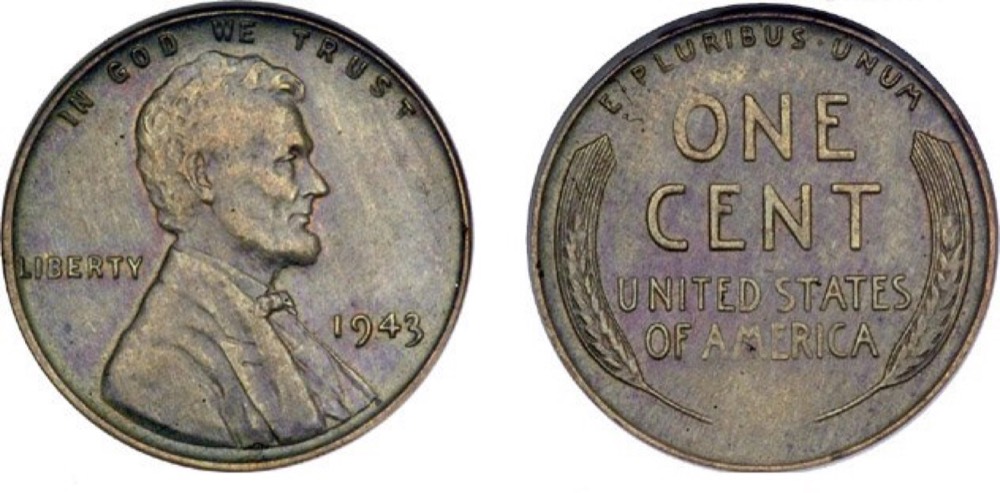
- 1943 cents were struck on zinc-coated steel, so a genuine 1943 cent sticks to a magnet and weighs about 2.7 grams. A 1943 cent that does not stick to a magnet is either a rare bronze error or, far more often, a fake: a copper-plated steel cent (still magnetic) or a 1948 cent with the 8 altered into a 3. Check the magnet first, then the shape of the 3 (the genuine 3 has a long, pointed lower tail), then weigh it.
- From 1918 onward the initials V.D.B. sit in tiny letters on the truncation of Lincoln's shoulder on the obverse. They are normal and do not add value; they are simply a way to confirm the coin's era.
- Wheat cents were struck in bronze (3.11 g) except for 1943. Genuine coins show a plain edge and a slightly lighter, more reddish colour than modern zinc cents when uncirculated; a brown, evenly worn coin is the normal state for this era and is not damage.
- True die doubling is rounded and separated; flat, shelf-like doubling is machine doubling and adds nothing. The mint marks guide has side-by-side examples.
How much is a 1943 penny worth?
PCGS Price Guide values for 1943 cents (updated September 24, 2026, U.S. dollars, for coins certified by PCGS):
- 1943: $1 in circulated grades (G4 to XF40); $22 in MS63 and $30 in MS65.
- 1943-D: $1 in circulated grades (G4 to XF40); $22 in MS63 and $30 in MS65.
- 1943-S: $1 in circulated grades (G4 to XF40); $22 in MS63 and $42 in MS65.
The 1943 coins that bring real money are the varieties and errors:
- 1943-D Bronze (BN): $1,700,000 in MS64 (Unique).
- 1943 Bronze (RD): $1,000,000 in MS63.
- 1943-S Bronze (BN): $175,000 in Extremely Fine (XF40) up to $1,000,000 in MS63 (5 known).
- 1943-D/D: $50 in Good (G4) up to $8,750 in MS67.
San Francisco is the lowest-mintage 1943 issue (191,550,000 struck), so it is the mint collectors check first. Guide prices assume a certified coin; an uncertified, worn 1943 cent usually sells for less than the lowest figure above, often a few cents in bulk wheat-cent lots. RD means full original red copper, RB red-brown, BN brown; the color grade can multiply the price. How grade and variety turn into a number is explained in what makes a coin valuable.
What a 1943 steel penny actually sells for
A worn 1943 steel cent sells for a few cents; Hero Bullion puts typical circulated examples at $0.05 to $0.20. The price climbs only for coins with no wear. PCGS Price Guide values (September 24, 2026) for the Philadelphia coin are $11 in MS60, $30 in MS65, $200 in MS67 and $4,250 in MS68; the 1943-D is $3,250 and the 1943-S $3,750 in MS68. Hero Bullion reports an MS68+ example sold for $33,600.
The one steel variety worth checking in any grade is the 1943-D/D repunched mint mark: PCGS lists it from $50 in Good to $8,750 in MS67. Under a magnifier you see a second D slightly offset from the first.
How to know if your 1943 steel penny is rare: five checks
- Magnet. A genuine steel cent sticks. If yours does not, it is either a bronze error or a fake; go to the copper-cent checks below.
- Weight. A steel cent weighs about 2.7 g (2.702 g per Wikipedia), 13% lighter than a bronze cent's 3.11 g.
- Surface. Bright, shiny steel cents that look new may be reprocessed: dealers stripped old coins and replated them with zinc or chrome, sometimes selling them as brilliant uncirculated (Wikipedia). A replated coin has little collector value.
- Edges and rust. Punching the blanks cut through the zinc and left the edges bare, so rust on the rim is normal on these coins and lowers the grade.
- Mint mark and grade. Look for the 1943-D/D; otherwise only an unworn coin grading MS67 or higher is worth sending to PCGS or NGC.
Why the 1943 cent was made of steel
Copper was needed for ammunition and other military equipment in World War II, so the Mint struck 1943 cents on steel coated with a thin layer of zinc (Wikipedia). The coins caused problems: their edges rusted, vending-machine magnets meant to catch steel slugs also caught the real cents, and new coins were often mistaken for dimes. In 1944 the Mint returned to a copper alloy made partly from recycled shell cases.
The 1943 copper penny: how many exist and what they sold for
A few 1943 cents were struck on bronze blanks left over from 1942. Wikipedia estimates about 40 were struck and 13 are confirmed; PCGS lists 10 to 15 known from Philadelphia, 5 from San Francisco and a single one from Denver. PCGS guide values (September 24, 2026) are $235,000 in XF40 and $1,000,000 in MS63 RD for the Philadelphia coin, $175,000 to $1,000,000 for the 1943-S and $1,700,000 for the 1943-D. The 1943-D was bought for $1.7 million in 2010 and sold for $840,000 at Heritage in June 2021 (CoinWeek).
Copies are common. The copper coin has been faked by copper-plating steel cents, which still stick to a magnet, and by altering the date of a later bronze cent, most often turning the 8 of a 1948 into a 3. CoinWeek's three checks: a genuine coin is not magnetic, weighs 3.11 g, and its 3 matches the style of the 3 on genuine steel cents; an altered date points to a fake. CoinWeek also advises that no coin worth over $500 be bought or sold without authentication.
Who buys 1943 steel pennies
Circulated steel cents are bought in bulk by coin shops and sold in rolls and sets, often next to the 1942–1945 silver wartime nickels (Hero Bullion). Pay for grading only for an unworn coin that could reach MS67 or better, a 1943-D/D, or a coin that fails the magnet test; those are sold through auction houses once certified by PCGS or NGC. The app identifies the date, mint mark and steel or copper appearance from a photo so you can sort a group first.
How this page was made
Research and drafting for this page were assisted by AI and checked line by line against the sources listed below. Prices are copied from the named price guide or auction report with its date; where a figure could not be confirmed we say so rather than estimate. If you find an error, tell us and we will correct it.
Tin penny, steel penny, 1943 wheat penny: the same coin
"Tin penny" is a popular name for the 1943 steel wheat penny. The coin contains no tin: it is steel with a thin zinc coating, weighing 2.702 g (Wikipedia). By contrast, the bronze cents made before and after it did contain a little tin (95% copper with tin and zinc until 1942). Wikipedia notes two other firsts: the 1943 cent is the only regular-issue U.S. coin that a magnet picks up, and the only U.S. circulating coin with no copper at all.
How rare is it to find a 1943 penny?
Not rare. The three mints struck about 1.09 billion steel cents in 1943. Many were pulled from circulation after copper returned in 1944, and First Coin Company's listing says most were destroyed, but CoinValueChecker still estimates about 68 million Philadelphia, 21 million Denver and 19 million San Francisco coins survive (page updated September 23, 2026). You are unlikely to find one in change today, but they are easy to buy.
What steel pennies cost to buy
Retail prices we checked on September 25, 2026:
- First Coin Company: a roll of 50 steel cents for $34.95, about 70 cents a coin, grade and mint not stated.
- Littleton Coin Company: a three-coin set with one each from Philadelphia, Denver and San Francisco for $8.50, offered in circulated, uncirculated or reprocessed condition.
Reprocessed means the old coating was stripped and the coin replated. Wikipedia says such coins have little or no collector value, so treat them as souvenirs. Those retail prices are also a ceiling on what a dealer pays you for a worn steel cent.
Which 1943 penny do you have? Magnet, weight and date
A 1943 penny is worth about 10 to 25 cents if it is the normal steel coin (U.S. Gold Bureau) and hundreds of thousands of dollars if it is one of the few bronze errors. Three tests decide which:
- Sticks to a magnet, about 2.7 g, gray: the normal steel cent. Value comes only from grade or the 1943-D/D variety.
- Does not stick, about 3.11 g, copper color, the 3 has a long tail: a possible bronze error. Stop handling it and have it authenticated by PCGS or NGC.
- Sticks to a magnet but looks copper: a steel cent plated with copper, a common fake.
- Does not stick, date looks like 1948 or the 3 is short: almost always a later bronze cent with an altered date.
Wikipedia adds a fourth check for the real bronze coin: its strike is exceptionally sharp, especially at the rim.
How many 1943 copper pennies exist, by source
Counts differ because each source counts differently:
- Wikipedia: about 40 struck, 13 confirmed; the first two were found in 1947 and another in 1958.
- PCGS Price Guide (September 24, 2026): 10 to 15 Philadelphia, 5 San Francisco, 1 Denver.
- CoinValueChecker (page updated September 23, 2026): 20 Philadelphia, 5 San Francisco and 1 Denver, 26 in total, out of up to 40 struck.
- Yahoo Finance: fewer than 20 remain.
Whichever figure you use, the San Francisco and Denver counts agree, and the unique 1943-D is the most valuable Lincoln cent in the PCGS guide at $1,700,000.
What are the odds of finding a 1943 copper penny?
Very low. The three mints struck 1,093,838,670 steel cents in 1943 (Wikipedia mintage tables). Using CoinValueChecker's 26 known bronze coins, that is about one bronze coin for every 42 million steel cents struck; using Wikipedia's 13 confirmed, about one in 84 million. Because copies are common, a copper-colored 1943 found today is far more likely to be copper-plated steel or an altered date than a genuine bronze coin.
Recent 1943 bronze cent sales
Reported by CoinValueChecker (page updated September 23, 2026):
- 1943-S bronze, MS63: $504,000, Heritage, November 2020.
- 1943-S bronze, AU55: $456,000, Sotheby's, March 2026.
- 1943-D bronze, MS64 (unique): $840,000, Heritage, January 2021.
The 1943-D had sold for more than $1.7 million in 2010 (Wikipedia), so even the rarest coin has fallen in price once. The PCGS guide (September 24, 2026) lists $175,000 in XF40 and $1,000,000 in MS63 for the 1943-S bronze.
Copper penny value: what a pre-1982 cent is worth in metal
The 1943 steel cent is the exception in a run of copper cents. Every Lincoln cent dated 1909 through 1981, apart from 1943, is 95% copper, and 1982 was made in both copper and zinc (Metalcharts). A 3.11 g copper cent contains 2.9545 g of copper.
- USA CoinBook, September 25, 2026: copper at $6.75 a pound, melt value $0.0446 per copper cent; a zinc cent after 1982 holds $0.0107 (USA CoinBook).
- Metalcharts, September 25, 2026: copper at $6.68 a pound, about 4.41 cents per coin; about 146 copper cents weigh a pound, $1.46 in face value holding about $6.44 of copper (Metalcharts).
So a copper penny is worth about four and a half cents in metal today, and the figure moves with the copper price. A 1943 steel cent has no copper value to speak of; its value is as a coin.
Which pennies are copper, and is any 100% copper?
No Lincoln cent is pure copper. Per Wikipedia's composition table):
- 1793–1857 large cents: about 100% copper, 13.5 g (1793–1795) and 10.9 g (1795–1857).
- 1864–1942 and 1947–1962: bronze, 95% copper with tin and zinc.
- 1944–1946 and 1962 to September 1982: 95% copper, 5% zinc.
- 1943: zinc-coated steel.
- October 1982 on: 97.5% zinc with a thin copper plating.
If you are asking which year of penny is 100% copper, the answer is the early large cents, not anything you will find in change.
Is it legal to melt copper pennies?
No. Federal regulation 31 CFR 82.1 says no person shall export, melt or treat any U.S. one-cent or five-cent coin unless the Treasury authorizes it (31 CFR 82.1). The penalty is a fine of up to $10,000, up to 5 years in prison, or both (31 CFR 82.4). The exceptions cover carrying up to $5 in cents and nickels abroad, shipping up to $25 for personal numismatic, amusement or recreational use, and treating coins for educational, novelty or jewelry purposes when the aim is not to profit from the metal (31 CFR 82.2). Saving and selling whole copper pennies is legal.
What that means for scrap: a scrap yard cannot legally buy pennies to melt, so there is no legal scrap price for them. People who save copper cents sell them as coins, usually in sorted bulk lots, or keep them.
How to sort copper pennies from zinc
- By date: 1981 and earlier (except 1943) is copper; 1983 and later is zinc.
- 1982: weigh it. Copper cents weigh 3.11 g and zinc cents 2.50 g (Metalcharts); see 1982.
- 1943: a magnet picks up the normal steel coin. A copper-colored 1943 that a magnet does not pick up and that weighs about 3.1 g needs authentication, because genuine 1943 bronze cents list $235,000 in XF40 BN in the PCGS Price Guide (September 24, 2026). Most turn out to be plated steel or altered dates; see the checks above.
FAQ
Is a 1943 penny with no mint mark rare?
No. A 1943 cent without a mint mark is the normal Philadelphia strike, and 684,628,670 were made.
What does the D on a 1943 penny mean?
D means the coin was struck at the Denver Mint. Denver made 217,660,000 cents in 1943, a normal share of the year's output.
Is a 1943-S penny valuable?
S means San Francisco, which struck 191,550,000 circulation cents in 1943, the lowest mintage of the year, so it is the issue collectors look for first. Value still depends on grade and on whether the coin is a recognised variety.
How do I know if my 1943 steel penny is rare?
Check the grade and the mint mark. A worn steel cent is common; an unworn one grading MS67 or higher, or a 1943-D/D repunched mint mark, is scarce. A 1943 cent that does not stick to a magnet needs authentication as a possible bronze error.
Which 1943 penny is worth $1,000,000?
The bronze (copper) 1943 cent, not the steel one. PCGS lists the Philadelphia bronze at $1,000,000 in MS63 RD, the 1943-S bronze at up to $1,000,000 and the unique 1943-D bronze at $1,700,000.
Who buys 1943 steel pennies?
Coin shops buy circulated steel cents in bulk for a few cents each. High-grade certified coins and authenticated errors are sold through auction houses.
Why is a 1943 steel cent potentially worth so much?
Because very few survive in perfect condition: PCGS lists $4,250 for a Philadelphia coin in MS68 against $1 in circulated grades. The famous six- and seven-figure 1943 cents are the bronze errors, not steel coins.
How much is a tin penny worth?
A "tin penny" is a 1943 steel cent. Worn ones sell for well under a dollar (a roll of 50 retails for $34.95); PCGS lists $30 in MS65 and $4,250 in MS68 (September 24, 2026).
Is a steel wheat penny worth anything?
A little: well under a dollar worn, $11 in MS60 and $30 in MS65 for a certified coin (PCGS). Real money is only in MS67 and above, the 1943-D/D, and steel errors dated 1944.
How much is a 1944 tin penny worth?
A genuine 1944 steel cent is a rare error: PCGS lists $46,000 to $170,000 for Philadelphia coins. See the [1944 penny page](/lookup/lincoln-cent/1944) for how to test one.
What makes a 1943-D steel penny rare?
The ordinary 1943-D is not rare (217,660,000 struck). Two things make one valuable: a top grade (PCGS $3,250 in MS68) or the 1943-D/D repunched mint mark ($50 in Good to $8,750 in MS67).
How much is a 1943-D steel wheat penny worth?
PCGS lists $1 in XF40, $30 in MS65, $185 in MS67 and $3,250 in MS68 (September 24, 2026).
How rare is it to find a 1943 penny?
Not rare to own: about 1.09 billion were struck and CoinValueChecker estimates over 100 million survive. They are rarely seen in change today.
Is a 1943 penny that sticks to a magnet worth anything?
A little. Sticking to a magnet means it is the normal steel cent: about 10 to 25 cents worn (U.S. Gold Bureau), $30 in MS65 and $4,250 in MS68 for a certified Philadelphia coin (PCGS, September 24, 2026). A 1943-D/D repunched mint mark is worth $50 even in Good.
How do I know if I have a 1943 copper penny?
It must fail the magnet test, weigh about 3.11 g, show a 3 with a long tail and have a sharp strike (Wikipedia). If all four match, have it authenticated; most copper-colored 1943 cents are plated steel or altered 1948 cents.
What are the odds of finding a 1943 copper penny?
About one for every 42 million steel cents struck in 1943, using CoinValueChecker's count of 26 known against the 1,093,838,670 steel cents made.
How many 1943 copper pennies are estimated to exist?
Between 13 confirmed (Wikipedia) and 26 (CoinValueChecker), from up to about 40 struck. PCGS lists 10 to 15 from Philadelphia, 5 from San Francisco and 1 from Denver.
Are copper pennies worth any money?
A little more than face: about 4.4 to 4.5 cents of copper each on September 25, 2026 (USA CoinBook, Metalcharts). Melting them is illegal, so that value is realized only by selling them as coins. Key dates and errors are worth far more.
What year of penny is 100% copper?
Only the early large cents of 1793–1857 are about 100% copper. Lincoln cents from 1909 to 1982 are 95% copper, and none of them is pure copper.
How much is a copper penny worth in scrap?
There is no legal scrap price, because melting cents is banned under 31 CFR 82. The copper content is worth about 4.46 cents (USA CoinBook, September 25, 2026, at $6.75 a pound).
How much is the copper in a pre-1982 penny worth?
It contains 2.9545 g of copper, worth about 4.41 cents at $6.68 a pound (Metalcharts) or 4.46 cents at $6.75 a pound (USA CoinBook), both on September 25, 2026.
More in Lincoln Penny Value by Year: 1909–2025 Price Chart
- 1940 Wheat Penny Value: Price Chart by Grade & Mint
- 1941 Wheat Penny Value: Price Chart by Grade & Mint
- 1942 Wheat Penny Value: Price Chart by Grade & Mint
- 1944 One Cent Penny Value: Wheat Cent and Steel Error Prices
- 1945 Wheat Penny Value: Price Chart by Grade & Mint
- 1946 Penny Value: Wheat Cent Price Chart by Grade & Mint
- 1947 Wheat Penny Value: Price Chart by Grade & Mint
- 1948 Wheat Penny Value: Price Chart by Grade & Mint
- 1949 Wheat Penny Value: Price Chart by Grade & Mint
Related
See what your coins are really worth.
Start with a single scan.
Have one? Scan it to see what it's worth.
Sources
- PCGS CoinFactswww.pcgs.com/prices/detail/lincoln-cent-wheat-reverse/46/most-active
- Wikipediaen.wikipedia.org/wiki/Lincoln_cent_mintage_figures
- Wikipediaen.wikipedia.org/wiki/Penny_(United_States_coin)
- Wikipediaen.wikipedia.org/wiki/Lincoln_cent
- PCGS CoinFactswww.pcgs.com/coinfacts/coin/1943-1c-bronze/3290
- PCGS CoinFactswww.pcgs.com/coinfacts/coin/1943-1c-bronze-bn/82709
- herobullion.comwww.herobullion.com/how-much-is-a-1943-steel-penny-worth/
- Wikipediaen.wikipedia.org/wiki/1943_steel_cent
- CoinWeekcoinweek.com/1943-d-lincoln-copper-cent-a-collectors-guide/
- fcmint.comwww.fcmint.com/roll-of-1943-steel-cents.html
- littletoncoin.comwww.littletoncoin.com/shop/1943-pds-wartime-steel-cent-set-st19-wc
- coinvaluechecker.comwww.coinvaluechecker.com/how-much-is-a-1943-steel-penny-worth/
- finance.yahoo.comfinance.yahoo.com/news/makes-1943-penny-worth-840-124304314.html
- coinvaluechecker.comwww.coinvaluechecker.com/how-much-is-a-1943-copper-penny-worth/
- usgoldbureau.comwww.usgoldbureau.com/news/post/what-is-worth-today-1943-steel-penny-value-silver
- metalcharts.orgmetalcharts.org/copper-penny-melt-value
- usacoinbook.comwww.usacoinbook.com/coin-melt-values/copper/
- 16 CFR 23 (Cornell LII)www.law.cornell.edu/cfr/text/31/82.1
- 16 CFR 23 (Cornell LII)www.law.cornell.edu/cfr/text/31/82.2
- 16 CFR 23 (Cornell LII)www.law.cornell.edu/cfr/text/31/82.4
Compiled by the CoinLens editorial team
Every fact on this page is taken from the sources listed above; numbers and prices are copied from the source, and prices name the guide or auction and its date. Research and drafting were assisted by AI, and each claim was then checked against the cited sources. Checked 2026-09-25. We do not buy, sell or grade items; the app identifies what you photograph and points you to these references.