1946 Penny Value: Wheat Cent Price Chart by Grade & Mint
Quick answer
1946 penny value: worn coins sell for about 20 cents; PCGS lists $20 in MS65 RD and $1,000 in MS67 RD. Mint marks, errors and how to tell if yours is rare.
Updated 2026-09-25 · Sources: PCGS CoinFacts, Wikipedia, jmbullion.com
Have one? Scan it to see what it's worth.
Download on the App StoreWhat are the key facts?
- Year: 1946
- Reverse design: Wheat reverse (1909-1958)
- Composition: 95% copper, 5% zinc (brass/"gilding metal")
- Weight: 3.11 g
- Diameter: 19.05 mm
- Mintage, no mint mark (Philadelphia): 991,655,000 circulation strikes
- Mintage, D (Denver): 315,690,000 circulation strikes
- Mintage, S (San Francisco): 198,100,000 circulation strikes
- Value, MS65 RD (1946, PCGS): $20
How many 1946 pennies were made
In 1946 the U.S. Mint struck about 1.51 billion Lincoln cents for circulation: Philadelphia 991.7 million, Denver 315.7 million, San Francisco 198.1 million. That is 1% more than 1945. Among the 117 years from 1909 to 2025, 1946 ranks number 68 by total mintage (1 = most coins made), so it is a mid-range date for availability. The scarcest 1946 issue by mintage is San Francisco (198,100,000); the most common is Philadelphia (991,655,000). Within the 1940s, 1946 ranks 2 of 10 years for mintage; the decade's high was 1944 (2.15 billion) and its low was 1949 (435.2 million). Mint by mint: Philadelphia fell 5% from 1945; Denver rose 19% from 1945; San Francisco rose 9% from 1945.
Mint marks on a 1946 penny
The mint mark, if any, sits under the date on the front of the coin. A 1946 cent with no mint mark was struck at Philadelphia and is the normal, common form for that mint. The letters you can find on 1946 circulation cents are D (Denver) and S (San Francisco).
What to check on a 1946 penny
- From 1918 onward the initials V.D.B. sit in tiny letters on the truncation of Lincoln's shoulder on the obverse. They are normal and do not add value; they are simply a way to confirm the coin's era.
- 1944 through 1946 cents were struck from recycled ammunition shell cases, a brass alloy without tin. They look like ordinary bronze cents. A 1944 cent that sticks to a magnet is a rare leftover steel planchet error and should be authenticated.
- Wheat cents were struck in bronze (3.11 g) except for 1943. Genuine coins show a plain edge and a slightly lighter, more reddish colour than modern zinc cents when uncirculated; a brown, evenly worn coin is the normal state for this era and is not damage.
- True die doubling is rounded and separated; flat, shelf-like doubling is machine doubling and adds nothing. The mint marks guide has side-by-side examples.
How much is a 1946 penny worth?
PCGS Price Guide values for 1946 cents (updated September 24, 2026, U.S. dollars, for coins certified by PCGS):
- 1946: $6 in MS63 RD and $20 in MS65 RD.
- 1946-D: $10 in MS63 RD and $24 in MS65 RD.
- 1946-S: $10 in MS63 RD and $18 in MS65 RD.
San Francisco is the lowest-mintage 1946 issue (198,100,000 struck), so it is the mint collectors check first. Guide prices assume a certified coin; an uncertified, worn 1946 cent usually sells for less than the lowest figure above, often a few cents in bulk wheat-cent lots. RD means full original red copper, RB red-brown, BN brown; the color grade can multiply the price. How grade and variety turn into a number is explained in what makes a coin valuable.
What a worn 1946 penny is worth
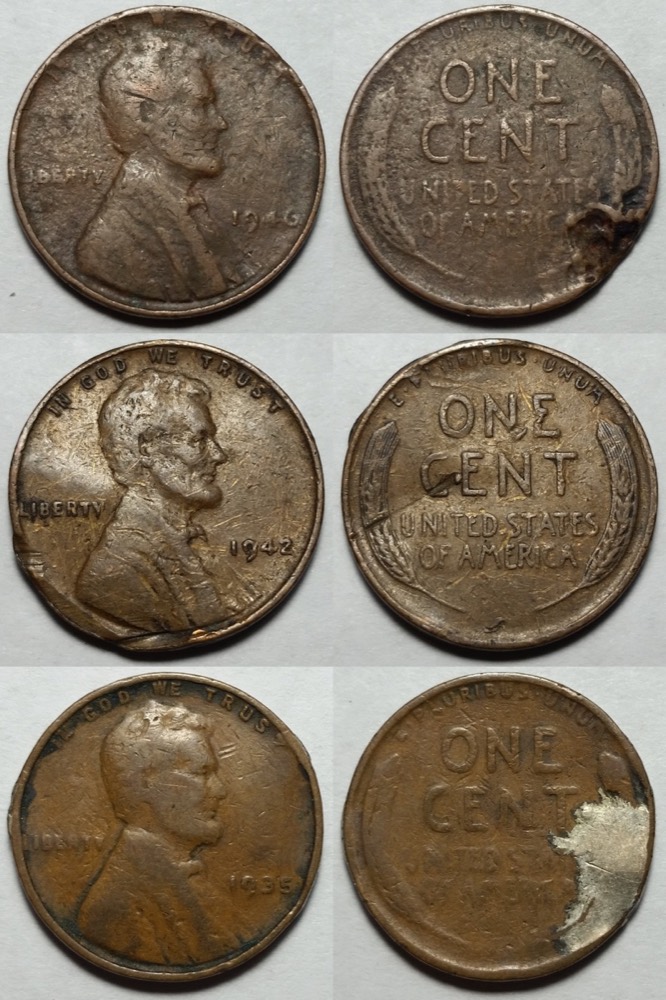
A circulated 1946 wheat penny is worth about 20 cents. The Red Book prices quoted by JM Bullion are $0.20 in Extremely Fine and $0.35 uncirculated for all three mints. The PCGS Price Guide (September 24, 2026) only prices uncirculated red coins, because worn 1946 cents are too common to certify:
- 1946: $3 in MS60, $20 in MS65, $100 in MS66, $1,000 in MS67.
- 1946-D: $2 in MS60, $24 in MS65, $32 in MS66, $275 in MS67.
- 1946-S: $5 in MS60, $18 in MS65, $26 in MS66, $225 in MS67.
The jump from MS66 to MS67 is where real money starts: a Philadelphia coin goes from $100 to $1,000.
What is special about a 1946 penny
1946 is the last of the three years (1944–1946) when cents were made with brass from salvaged ammunition shell cases plus copper (Wikipedia, Penny). It looks like any other wheat cent and should not stick to a magnet. It was also a very large year: 1.51 billion cents, the second-highest total of the 1940s (Wikipedia mintage tables). So a 1946 cent is interesting history, but rarity only comes from condition or a mint error.
Errors on a 1946 penny
The PCGS Price Guide (September 24, 2026) lists no named die variety for 1946, so there is no single famous 1946 error like the 1955 doubled die. What you can find are the general mint errors that occur in any year (Wikipedia, Mint-made errors):
- Off-center strikes, where part of the design is missing and a blank crescent shows.
- Wrong-planchet strikes, a cent design on a blank meant for another coin; the size, weight or color will not match a normal 3.11 g cent.
- Doubling: check the date and LIBERTY; rounded, separated outlines are worth a second look, flat shelf-like doubling is machine damage.
Damage after the coin left the Mint (scratches, plating, flattening) is often mistaken for an error and adds nothing.
FAQ
Is a 1946 penny with no mint mark rare?
No. A 1946 cent without a mint mark is the normal Philadelphia strike, and 991,655,000 were made.
What does the D on a 1946 penny mean?
D means the coin was struck at the Denver Mint. Denver made 315,690,000 cents in 1946, a normal share of the year's output.
Is a 1946-S penny valuable?
S means San Francisco, which struck 198,100,000 circulation cents in 1946, the lowest mintage of the year, so it is the issue collectors look for first. Value still depends on grade and on whether the coin is a recognised variety.
How do I know if my 1946 penny is rare?
Only an unworn coin with full red color that could grade MS67, or a genuine mint error, is rare. A worn 1946 is worth about 20 cents (Red Book via JM Bullion); PCGS lists $1,000 for a Philadelphia coin in MS67 RD.
What wheat penny is worth $1,000,000?
The 1943 bronze cents (Philadelphia and San Francisco, $1,000,000 in MS63) and the 1958 doubled die ($1,140,000 in MS65 RD); the unique 1943-D bronze is listed at $1,700,000 (PCGS, September 24, 2026). No 1946 cent is close.
What is the error on the 1946 penny?
There is no famous one: PCGS lists no named 1946 variety. Look for general errors such as off-center or wrong-planchet strikes, and confirm them by weight and size.
What is special about a 1946 penny?
It is the last year of the wartime shell-case brass cents (1944–1946) and one of the largest mintages of the 1940s at 1.51 billion.
More in Lincoln Penny Value by Year: 1909–2025 Price Chart
- 1940 Wheat Penny Value: Price Chart by Grade & Mint
- 1941 Wheat Penny Value: Price Chart by Grade & Mint
- 1942 Wheat Penny Value: Price Chart by Grade & Mint
- 1943 Steel Cent Value: Steel Penny Prices and Copper Error
- 1944 One Cent Penny Value: Wheat Cent and Steel Error Prices
- 1945 Wheat Penny Value: Price Chart by Grade & Mint
- 1947 Wheat Penny Value: Price Chart by Grade & Mint
- 1948 Wheat Penny Value: Price Chart by Grade & Mint
- 1949 Wheat Penny Value: Price Chart by Grade & Mint
Related
See what your coins are really worth.
Start with a single scan.
Have one? Scan it to see what it's worth.
Sources
- PCGS CoinFactswww.pcgs.com/prices/detail/lincoln-cent-wheat-reverse/46/most-active
- Wikipediaen.wikipedia.org/wiki/Lincoln_cent_mintage_figures
- Wikipediaen.wikipedia.org/wiki/Lincoln_cent
- jmbullion.comwww.jmbullion.com/coin-info/cents/lincoln-pennies/1946-lincoln-penny/
- Wikipediaen.wikipedia.org/wiki/Penny_(United_States_coin)
- Wikipediaen.wikipedia.org/wiki/Mint-made_errors
Compiled by the CoinLens editorial team
Every fact on this page is taken from the sources listed above; numbers and prices are copied from the source, and prices name the guide or auction and its date. Research and drafting were assisted by AI, and each claim was then checked against the cited sources. Checked 2026-09-25. We do not buy, sell or grade items; the app identifies what you photograph and points you to these references.