1944 One Cent Penny Value: Wheat Cent and Steel Error Prices
Quick answer
1944 one cent penny value: a common wheat cent is $0.20–$0.35, $18 in MS65; the rare steel error is $46,000 to $525,000 (PCGS, Sept 2026).
Updated 2026-09-25 · Sources: PCGS CoinFacts, Wikipedia, jmbullion.com, northernillinoiscoin.com
Have one? Scan it to see what it's worth.
Download on the App StoreWhat are the key facts?
- Year: 1944
- Reverse design: Wheat reverse (1909-1958)
- Composition: 95% copper, 5% zinc (brass/"gilding metal")
- Weight: 3.11 g
- Diameter: 19.05 mm
- Mintage, no mint mark (Philadelphia): 1,435,000,000 circulation strikes
- Mintage, D (Denver): 430,578,000 circulation strikes
- Mintage, S (San Francisco): 282,760,000 circulation strikes
- Value, MS65 RD (1944, PCGS): $18
- Top variety (PCGS): 1944-S Steel: up to $525,000
How many 1944 pennies were made
In 1944 the U.S. Mint struck about 2.15 billion Lincoln cents for circulation: Philadelphia 1.44 billion, Denver 430.6 million, San Francisco 282.8 million. That is 96% more than 1943. Among the 117 years from 1909 to 2025, 1944 ranks number 65 by total mintage (1 = most coins made), so it is a mid-range date for availability. The scarcest 1944 issue by mintage is San Francisco (282,760,000); the most common is Philadelphia (1,435,000,000). Within the 1940s, 1944 ranks 1 of 10 years for mintage; the decade's high was 1944 (2.15 billion) and its low was 1949 (435.2 million). Mint by mint: Philadelphia rose 110% from 1943; Denver rose 98% from 1943; San Francisco rose 48% from 1943.
Mint marks on a 1944 penny
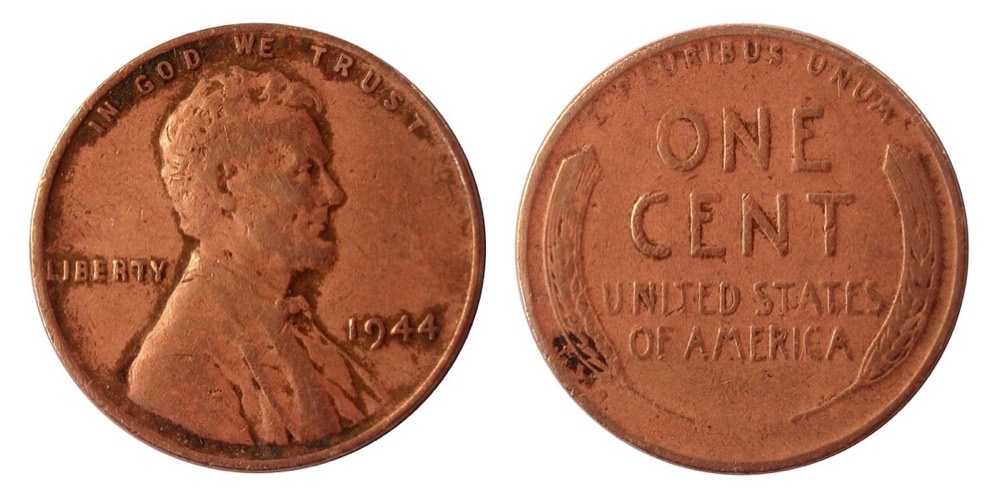
The mint mark, if any, sits under the date on the front of the coin. A 1944 cent with no mint mark was struck at Philadelphia and is the normal, common form for that mint. The letters you can find on 1944 circulation cents are D (Denver) and S (San Francisco).
What to check on a 1944 penny
- From 1918 onward the initials V.D.B. sit in tiny letters on the truncation of Lincoln's shoulder on the obverse. They are normal and do not add value; they are simply a way to confirm the coin's era.
- 1944 through 1946 cents were struck from recycled ammunition shell cases, a brass alloy without tin. They look like ordinary bronze cents. A 1944 cent that sticks to a magnet is a rare leftover steel planchet error and should be authenticated.
- Wheat cents were struck in bronze (3.11 g) except for 1943. Genuine coins show a plain edge and a slightly lighter, more reddish colour than modern zinc cents when uncirculated; a brown, evenly worn coin is the normal state for this era and is not damage.
- Before anything else, confirm the date and mint mark are fully readable and that the surfaces have not been cleaned; the dates and mint marks guide shows what cleaning and machine doubling look like.
How much is a 1944 penny worth?
PCGS Price Guide values for 1944 cents (updated September 24, 2026, U.S. dollars, for coins certified by PCGS):
- 1944: $8 in MS63 RD and $18 in MS65 RD.
- 1944-D: $10 in MS63 RD and $24 in MS65 RD.
- 1944-S: $10 in MS63 RD and $18 in MS65 RD.
The 1944 coins that bring real money are the varieties and errors:
- 1944-S Steel: $525,000 in MS66 (2 known).
- 1944 Steel: $46,000 in MS60 up to $170,000 in MS64 (an estimated 25-30 known).
- 1944-D Steel: $55,000 in MS60 up to $165,000 in MS63 (7 known).
- 1944-D/S (RD): $400 in MS60 up to $26,000 in MS67.
San Francisco is the lowest-mintage 1944 issue (282,760,000 struck), so it is the mint collectors check first. Guide prices assume a certified coin; an uncertified, worn 1944 cent usually sells for less than the lowest figure above, often a few cents in bulk wheat-cent lots. RD means full original red copper, RB red-brown, BN brown; the color grade can multiply the price. How grade and variety turn into a number is explained in what makes a coin valuable.
Is a 1944 penny worth anything? Prices for worn coins
A normal 1944 wheat penny is worth a little more than face value. The Red Book figures quoted by JM Bullion are $0.20 in Extremely Fine and $0.35 Uncirculated, the same for all three mints. A coin shop sells mixed 1940s and 1950s wheat cents at $5.25 per roll of 50 and $495 per bag of 5,000 (Northern Illinois Coin & Stamp, listed September 25, 2026), so a dealer buying a common 1944 pays less than about 10 cents. The PCGS values above ($8 in MS63 RD, $18 in MS65 RD) apply to certified, unworn coins.
1944 has the largest cent mintage of the 1940s, about 2.15 billion, which is why ordinary 1944 cents are so common.
How to tell if your 1944 penny is valuable
- Magnet test first. A normal 1944 cent is a copper alloy and does not stick. One that sticks may be a steel error; weigh it (a steel cent is about 2.7 g, a normal one 3.11 g) and send it for authentication.
- Look under the D. On 1944-D cents, check for traces of an S under the D. That is the 1944-D/S, listed by PCGS from $45 in Good to $26,000 in MS67 RD.
- Color and wear. An unworn coin with full original red color is worth several times a brown one; a worn coin is a common date.
- Streaks are normal. Cents of 1944 to 1946 were made partly from salvaged shell cases and can show brass streaks or a darker finish (Wikipedia). This is not an error and adds no value.
- Doubling. Rounded, separated doubling in the date or lettering is worth checking; flat, shelf-like doubling is machine damage.
Why the 1944 steel penny is so rare
In 1944 the Mint went back to copper, but a few leftover zinc-plated steel planchets from 1943 were struck with 1944 dies by mistake; CoinWeek adds that some blanks may have come from foreign coins the Mint was making, for countries such as the Netherlands. PCGS counts an estimated 25 to 30 from Philadelphia, 7 from Denver and 2 from San Francisco, and lists them at $46,000 to $170,000, $55,000 to $165,000 and $525,000 respectively (September 24, 2026). The only Mint State 1944-S steel, graded PCGS MS66, sold for $408,000 in 2021 (CoinWeek).
Fakes exist here too: a 1943 steel cent with the 3 altered to a 4 will stick to a magnet. The shape of the 4 and the weight help, but authentication is the only reliable answer for a coin priced like this.
Where a 1944 fits among wheat cents
The 1944 is a late wheat cent: the wheat-ear reverse ran from 1909 to 1958. Late wheat cents are common, and the money in the series is in the early San Francisco and Denver key dates and in the error coins. If you have a jar of wheat pennies, see wheat penny value for what dealers pay and which coins to keep, and most valuable wheat pennies for the full ranked list.
How this page was made
Research and drafting for this page were assisted by AI and checked line by line against the sources listed below. Prices are copied from the named price guide or auction report with its date; where a figure could not be confirmed we say so rather than estimate. If you find an error, tell us and we will correct it.
1944 steel cent value by mint and grade
A genuine 1944 steel cent is worth tens of thousands of dollars even in the lowest Mint State grades. PCGS Price Guide values (September 24, 2026):
- 1944 steel (Philadelphia): $46,000 in MS60, $87,500 in MS63, $170,000 in MS64.
- 1944-D steel: $55,000 in MS60, $165,000 in MS63.
- 1944-S steel: $525,000 in MS66.
Reported auction results, as listed by CoinValueChecker (page updated September 23, 2026): a 1944 in MS64 for $180,000 (Heritage, June 2021) and a 1944-D in MS62 for $122,000 (Heritage, January 2026). Wikipedia reports a 1944-S steel sold for $373,750 in August 2008, which held the Lincoln cent record until a 1943-D bronze sold for $1.7 million in September 2010.
How many 1944 steel pennies exist
No exact count exists. PCGS estimates 25 to 30 from Philadelphia, 7 from Denver and 2 from San Francisco; CoinValueChecker gives 25 to 40 for Philadelphia. That puts the total at roughly 34 to 49 coins, against more than 2.1 billion normal 1944 cents. Wikipedia gives two explanations for how they were made: steel blanks left over from 1943 mixed into the hoppers, or the Philadelphia Mint's production of 25 million Belgian two-franc coins after Belgium's liberation.
How to tell if your 1944 wheat penny is steel
- Color. A steel cent is silvery gray, not reddish brown (CoinValueChecker). A worn one can look dark gray with rust spots.
- Magnet. Steel sticks; the normal 1944 copper alloy does not.
- Weight. Steel is about 2.7 g (2.702 g per Wikipedia); a normal 1944 cent is 3.11 g.
- Rule out plating. A copper cent plated silver will not stick to a magnet and will weigh 3.11 g, so it fails both tests.
- Rule out an altered date. A 1943 steel cent with the 3 changed to a 4 passes the magnet and weight tests, so the last check is authentication by PCGS or NGC.
If your coin passes the first three checks, keep it in a holder and do not clean it before sending it in.
FAQ
Is a 1944 penny with no mint mark rare?
No. A 1944 cent without a mint mark is the normal Philadelphia strike, and 1,435,000,000 were made.
What does the D on a 1944 penny mean?
D means the coin was struck at the Denver Mint. Denver made 430,578,000 cents in 1944, a normal share of the year's output.
Is a 1944-S penny valuable?
S means San Francisco, which struck 282,760,000 circulation cents in 1944, the lowest mintage of the year, so it is the issue collectors look for first. Value still depends on grade and on whether the coin is a recognised variety.
How do I tell if my 1944 penny is valuable?
Try a magnet (a 1944 that sticks may be a steel error), check a 1944-D for an S under the D, and look at wear and color. A worn, brown 1944 with none of these features is worth about 20 cents.
What is so rare about a 1944 penny?
The ordinary coin is not rare; over 2 billion were made. The rare ones are the steel errors (about 25 to 30 from Philadelphia, 7 from Denver, 2 from San Francisco) and the 1944-D/S overmintmark.
What wheat penny is worth $1,000,000?
The 1943 bronze cents and the 1958 Doubled Die. PCGS lists the 1943 bronze at $1,000,000 in MS63 RD and the 1958 Doubled Die at $1,140,000 in MS65 RD; a 1958 Doubled Die sold for $1,136,250 in 2023.
Who buys 1944 wheat pennies?
Coin shops buy common 1944 cents in bulk for less than 10 cents each. A steel 1944 or a 1944-D/S should be authenticated by PCGS or NGC and sold through a specialist or auction house.
Is a 1944 old penny worth anything?
A little: about $0.20 to $0.35 for a normal coin, $18 in certified MS65 RD, and far more only for the errors.
What is the error on the 1944 wheat penny?
The main ones are the steel-planchet cents struck by mistake on leftover 1943 blanks and the 1944-D/S, where a D was punched over an S.
What will dealers pay for a 1944 wheat penny?
Less than the retail price of about 10.5 cents each for common 1940s–50s wheats sold by the roll (Northern Illinois Coin & Stamp, September 25, 2026).
How many 1944 steel pennies exist?
About 34 to 49 in total: PCGS estimates 25 to 30 from Philadelphia, 7 from Denver and 2 from San Francisco (CoinValueChecker puts Philadelphia at 25 to 40).
What is the current value of a 1944-D steel penny?
PCGS lists $55,000 in MS60 and $165,000 in MS63 (September 24, 2026). A 1944-D in MS62 sold for $122,000 at Heritage in January 2026 (reported by CoinValueChecker).
How can I tell if my 1944 wheat penny is steel?
It will be silvery gray, stick to a magnet and weigh about 2.7 g instead of 3.11 g. Because altered 1943 cents pass those tests too, have it authenticated.
Why is a 1944 steel penny worth so much?
Because only about three to five dozen were made by mistake, against more than 2.1 billion normal 1944 cents, and collectors of Lincoln cents compete for them.
More in Lincoln Penny Value by Year: 1909–2025 Price Chart
- 1940 Wheat Penny Value: Price Chart by Grade & Mint
- 1941 Wheat Penny Value: Price Chart by Grade & Mint
- 1942 Wheat Penny Value: Price Chart by Grade & Mint
- 1943 Steel Cent Value: Steel Penny Prices and Copper Error
- 1945 Wheat Penny Value: Price Chart by Grade & Mint
- 1946 Penny Value: Wheat Cent Price Chart by Grade & Mint
- 1947 Wheat Penny Value: Price Chart by Grade & Mint
- 1948 Wheat Penny Value: Price Chart by Grade & Mint
- 1949 Wheat Penny Value: Price Chart by Grade & Mint
Related
See what your coins are really worth.
Start with a single scan.
Have one? Scan it to see what it's worth.
Sources
- PCGS CoinFactswww.pcgs.com/prices/detail/lincoln-cent-wheat-reverse/46/most-active
- Wikipediaen.wikipedia.org/wiki/Lincoln_cent_mintage_figures
- Wikipediaen.wikipedia.org/wiki/Lincoln_cent
- jmbullion.comwww.jmbullion.com/coin-info/cents/lincoln-pennies/1944-lincoln-penny/
- northernillinoiscoin.comwww.northernillinoiscoin.com/wheat-cents/
- CoinWeekcoinweek.com/rare-1944-s-lincoln-steel-penny-to-sell-at-greatcollections/
- Wikipediaen.wikipedia.org/wiki/Penny_(United_States_coin)
- Wikipediaen.wikipedia.org/wiki/1943_steel_cent
- coinvaluechecker.comwww.coinvaluechecker.com/how-much-is-a-1944-steel-penny-worth/
Compiled by the CoinLens editorial team
Every fact on this page is taken from the sources listed above; numbers and prices are copied from the source, and prices name the guide or auction and its date. Research and drafting were assisted by AI, and each claim was then checked against the cited sources. Checked 2026-09-25. We do not buy, sell or grade items; the app identifies what you photograph and points you to these references.