1955 Penny Value: Doubled Die Price & Mint Chart
Quick answer
1955 penny value: PCGS lists $22 in MS65; the 1955 Doubled Die Obverse reaches $65,000. Mintage, mint marks and what to check.
Updated 2026-09-25 · Sources: PCGS CoinFacts, Wikipedia, coinvaluechecker.com, CoinWeek
Have one? Scan it to see what it's worth.
Download on the App StoreWhat are the key facts?
- Year: 1955
- Reverse design: Wheat reverse (1909-1958)
- Composition: 95% copper, 2.5% tin, 2.5% zinc (bronze)
- Weight: 3.11 g
- Diameter: 19.05 mm
- Mintage, no mint mark (Philadelphia): 330,580,000 circulation strikes, 378,200 proofs
- Mintage, D (Denver): 563,257,500 circulation strikes
- Mintage, S (San Francisco): 44,610,000 circulation strikes
- Value, MS65 RD (1955, PCGS): $22
- Top variety (PCGS): 1955 Doubled Die Obverse: up to $65,000
How many 1955 pennies were made
In 1955 the U.S. Mint struck about 938.4 million Lincoln cents for circulation: Philadelphia 330.6 million, Denver 563.3 million, San Francisco 44.6 million. That is 124% more than 1954. Among the 117 years from 1909 to 2025, 1955 ranks number 80 by total mintage (1 = most coins made), so it is a mid-range date for availability. The scarcest 1955 issue by mintage is San Francisco (44,610,000); the most common is Denver (563,257,500). Within the 1950s, 1955 ranks 8 of 10 years for mintage; the decade's high was 1959 (1.89 billion) and its low was 1954 (419.4 million). Mint by mint: Philadelphia rose 361% from 1954; Denver rose 124% from 1954; San Francisco fell 54% from 1954. Proof cents for collectors: 378,200 from Philadelphia.
Mint marks on a 1955 penny
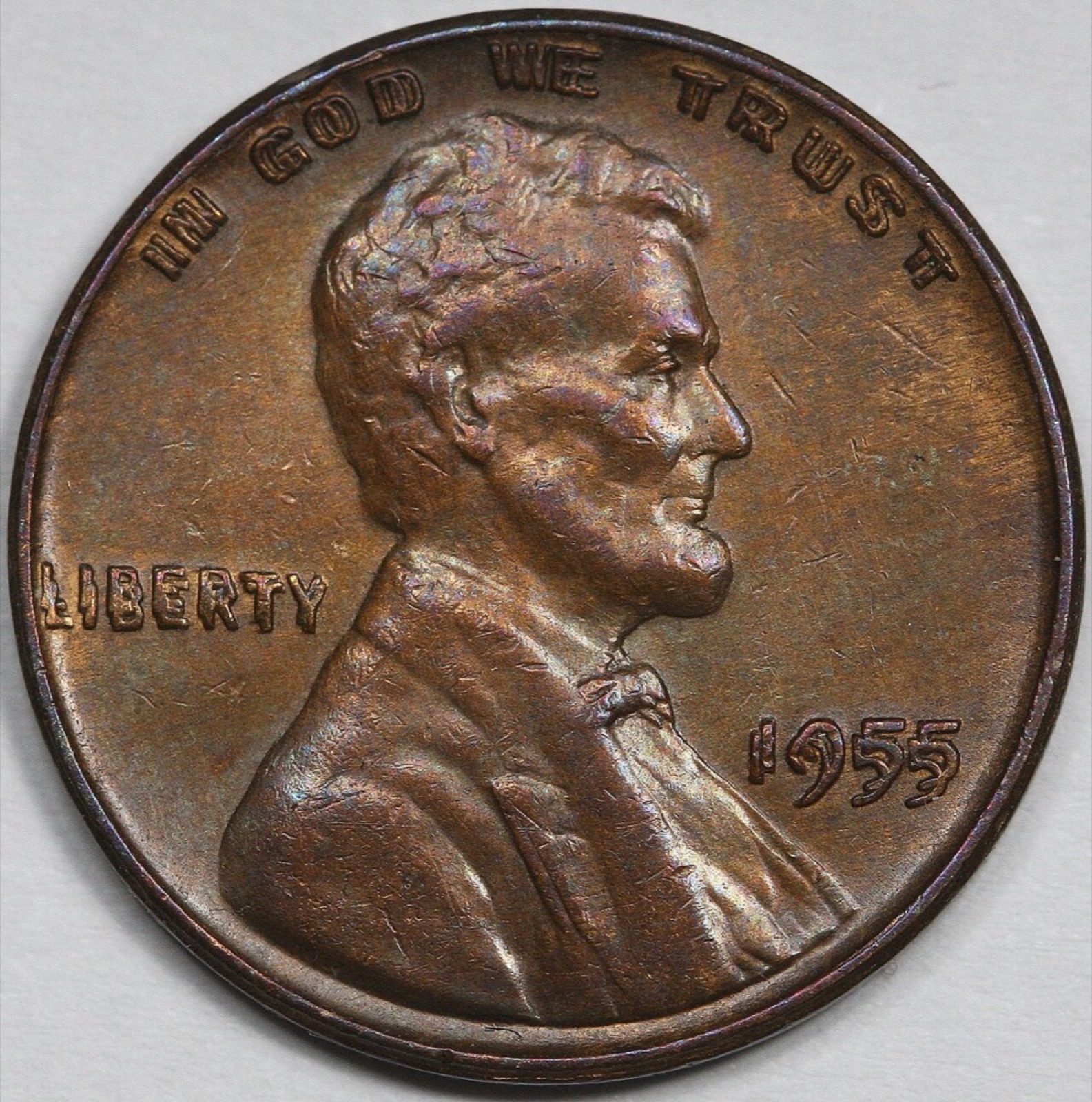
The mint mark, if any, sits under the date on the front of the coin. A 1955 cent with no mint mark was struck at Philadelphia and is the normal, common form for that mint. The letters you can find on 1955 circulation cents are D (Denver) and S (San Francisco). Proof cents for 1955 were struck at Philadelphia with no mint mark; they have mirror-like fields and came from collector sets, not from circulation.
What to check on a 1955 penny
- 1955 doubled-die obverse. A dramatic, naked-eye-visible doubling of the date, LIBERTY, and IN GOD WE TRUST caused by a misaligned hubbing; widely credited with launching mainstream collector interest in doubled-die varieties.
- 1955 is the year of the famous doubled die obverse: the date, LIBERTY and IN GOD WE TRUST show clear, separated doubling visible without a loupe. Do not confuse it with the common 'poor man's doubled die', where only the 5s look slightly thickened from a worn die, or with machine doubling, which looks flat and shelf-like.
- From 1918 onward the initials V.D.B. sit in tiny letters on the truncation of Lincoln's shoulder on the obverse. They are normal and do not add value; they are simply a way to confirm the coin's era.
- Wheat cents were struck in bronze (3.11 g) except for 1943. Genuine coins show a plain edge and a slightly lighter, more reddish colour than modern zinc cents when uncirculated; a brown, evenly worn coin is the normal state for this era and is not damage.
- True die doubling is rounded and separated; flat, shelf-like doubling is machine doubling and adds nothing. The mint marks guide has side-by-side examples.
How much is a 1955 penny worth?
PCGS Price Guide values for 1955 cents (updated September 24, 2026, U.S. dollars, for coins certified by PCGS):
- 1955: $9 in MS63 RD and $22 in MS65 RD.
- 1955-D: $8 in MS63 RD and $20 in MS65 RD.
- 1955-S: $5 in MS63 RD and $18 in MS65 RD.
The 1955 coins that bring real money are the varieties and errors:
- 1955 Doubled Die Obverse (RD): $3,750 in MS60 up to $65,000 in MS65.
San Francisco is the lowest-mintage 1955 issue (44,610,000 struck), so it is the mint collectors check first. Guide prices assume a certified coin; an uncertified, worn 1955 cent usually sells for less than the lowest figure above, often a few cents in bulk wheat-cent lots. RD means full original red copper, RB red-brown, BN brown; the color grade can multiply the price. How grade and variety turn into a number is explained in what makes a coin valuable.
1955 doubled die: how many exist and what they sell for
About 40,000 doubled die cents were struck during one night shift at the Philadelphia Mint, and roughly 20,000 to 24,000 were released, many through cigarette vending machines (Wikipedia). CoinValueChecker estimates 10,000 to 15,000 survive (CoinValueChecker).
PCGS Price Guide (September 24, 2026):
- Brown (BN): $875 in Good 4, $2,000 in XF40, $3,500 in MS60, $9,000 in MS65, $30,500 in MS66.
- Red-brown (RB): $3,750 in MS60 to $18,000 in MS65.
- Red (RD): $3,750 in MS60 to $65,000 in MS65.
The record: a PCGS MS65+ RD sold for $287,156.25 at GreatCollections in January 2023 (CoinValueChecker; CoinWeek reports the same coin at $287,156). All doubled die years are compared on double die penny.
Poor man's doubled die and other 1955 look-alikes
- Poor man's doubled die: only the last 5 of the date looks thick or doubled, from die wear. It sells for a few dollars (Wikipedia).
- Machine doubling: flat, shelf-like edges on the letters; it adds nothing.
- Counterfeits: many fakes of the real doubled die exist. Wikipedia notes that genuine coins show vertical die polishing lines to the left of the T in ONE CENT on the back. Buy only certified examples.
On the real coin, the doubling on the date, LIBERTY and IN GOD WE TRUST is plain to the naked eye. If you need a strong loupe to see it, it is almost certainly not the 1955 doubled die.
1955-S: the last S-mint cent until 1968
After 1955, San Francisco did not strike S-marked cents again until 1968 (the 1964–1967 San Francisco cents carry no mint mark, per the mintage tables on our 1968 page). Collectors expected the 1955-S to be the last and saved it in rolls (CoinValueChecker). That is why it has the lowest 1955 mintage (44,610,000) but is still cheap: PCGS lists it at $18 in MS65 RD. Only near-perfect coins bring more, $150 in MS67 RD and $10,000 in MS68 RD (PCGS, September 24, 2026).
Is your wheat penny worth money? A five-point check
- Date and mint mark: compare with the key dates on most valuable wheat pennies. The big ones are 1909-S VDB, 1914-D, 1922 No D and 1931-S.
- Doubling: check the date, LIBERTY and IN GOD WE TRUST for rounded, separated doubling.
- Metal: a 1943 should be steel and stick to a magnet; a 1944 should not.
- Color: full red uncirculated coins are worth several times brown ones in the same grade. For a common 1955, PCGS lists $22 in MS65 RD.
- Surface: cleaned, scratched or corroded coins lose most of their premium.
If none of these applies, a worn wheat cent is usually worth a few cents to a dollar; see wheat penny value.
FAQ
Is a 1955 penny with no mint mark rare?
No. A 1955 cent without a mint mark is the normal Philadelphia strike, and 330,580,000 were made.
What does the D on a 1955 penny mean?
D means the coin was struck at the Denver Mint. Denver made 563,257,500 cents in 1955, the most of any mint that year.
Is a 1955-S penny valuable?
S means San Francisco, which struck 44,610,000 circulation cents in 1955, the lowest mintage of the year, so it is the issue collectors look for first. Value still depends on grade and on whether the coin is a recognised variety.
What year is penny worth $20,000?
No single year; it depends on variety and grade. Examples near $20,000 in the PCGS Price Guide (September 24, 2026): 1955 Doubled Die Obverse MS65 RB $18,000, 1914-D MS65 RD $17,500, 1992 Close AM MS64 RD $20,000, and 1917 Doubled Die Obverse MS65 RD $24,000.
Is a 1955 wheat penny with no mint mark valuable?
Usually not: 330,580,000 were struck at Philadelphia, and PCGS lists it at $22 in MS65 RD. It is valuable only if it is the Doubled Die Obverse, which was struck only at Philadelphia and so also has no mint mark ($875 in Good 4 and up).
How do you know if your wheat penny is worth money?
Check five things: a key date and mint mark, real doubling, the right metal for 1943 and 1944, full red color in uncirculated condition, and an uncleaned surface. If none applies, it is usually worth a few cents to a dollar.
More in Lincoln Penny Value by Year: 1909–2025 Price Chart
- 1950 Wheat Penny Value: Price Chart by Grade & Mint
- 1951 Wheat Penny Value: Price Chart by Grade & Mint
- 1952 Wheat Penny Value: Price Chart by Grade & Mint
- 1953 Wheat Penny Value: Price Chart by Grade & Mint
- 1954 Wheat Penny Value: Price Chart by Grade & Mint
- 1956 Wheat Penny Value: Price Chart by Grade & Mint
- 1957 Wheat Penny Value: Price Chart by Grade & Mint
- 1958 Wheat Penny Value: Price Chart by Grade & Mint
- 1959 Penny Value: Price Chart by Grade & Mint Mark
Related
See what your coins are really worth.
Start with a single scan.
Have one? Scan it to see what it's worth.
Sources
- PCGS CoinFactswww.pcgs.com/prices/detail/lincoln-cent-wheat-reverse/46/most-active
- Wikipediaen.wikipedia.org/wiki/Lincoln_cent_mintage_figures
- Wikipediaen.wikipedia.org/wiki/Lincoln_cent
- PCGS CoinFactswww.pcgs.com/coinfacts/coin/1955-1c-doubled-die-obverse-bn/2825
- PCGS CoinFactswww.pcgs.com/news/the-1955-doubled-die-lincoln-cent-turns-70
- Wikipediaen.wikipedia.org/wiki/1955_doubled_die_cent
- coinvaluechecker.comwww.coinvaluechecker.com/how-much-is-a-1955-wheat-penny-worth/
- CoinWeekcoinweek.com/the-12-rare-lincoln-cent-double-dies-that-collectors-chase/
Compiled by the CoinLens editorial team
Every fact on this page is taken from the sources listed above; numbers and prices are copied from the source, and prices name the guide or auction and its date. Research and drafting were assisted by AI, and each claim was then checked against the cited sources. Checked 2026-09-25. We do not buy, sell or grade items; the app identifies what you photograph and points you to these references.